A longer breath-hold isn't about bigger lungs. It's about CO₂ tolerance and staying calm when the urge to breathe hits. Train it from home, on the floor, in 15 minutes a day. No water needed.

The real limit
When your breath-hold ends, it's almost never because you ran out of oxygen. It ends because carbon dioxide builds up, your diaphragm starts contracting, and your body convinces you that you have to breathe right now. That signal is a chemical alarm, not a countdown.
CO₂ tolerance training teaches your nervous system to read that alarm differently. The contractions still come. You just stop panicking at them, stop burning oxygen on tension, and hold on calmly for another 30, 60, 90 seconds. Calm first, numbers second — that order is the whole method.
Your body's response to rising CO₂ is trainable. Repeated, structured exposure blunts the panic and lets you stay relaxed deep into a hold.
Tension burns oxygen. Learning to release the jaw, shoulders and stomach during a hold buys you time nothing else can.
All of it can be built on a mat at home, safely, before you ever take it to the pool, the reef or the depth line.
Freediving breathwork
Breathwork for freedivers is not the fast, intense breathing you'll find in general wellness classes. Here, breathing has three jobs: calm the nervous system before the hold, fill the lungs without tension, and recover cleanly afterwards. Everything else is decoration.
Done well, breathwork lowers your heart rate and drops your oxygen consumption before you've held a single second. Done badly — rushed, forced, or over-ventilated — it makes a hold shorter and considerably more dangerous.
Before any hold, spend ten minutes getting the body and the head into the right place. This is the part almost everyone skips, and it's the part that changes how the whole hold feels.
The two minutes before the hold are tidal breathing — normal, light, unforced. Not big breaths. Not deep breaths. Just quiet ones with a soft, long exhale.
During those two minutes the mind slows and the heart rate drops. Release the chest, the neck, the shoulders. Shut everything else out and be in your own world. Then take one final breath: fill the lungs completely, one big inhale, without straining. Tension in the chest at that moment costs you a minute later on.
When the hold ends, take four big active recovery breaths — every single time, even when you feel completely fine and don't think you need them. Build it now, while holds are short and the stakes are low, so it's muscle memory by the time they get long. Recovery breathing is a safety skill, not an afterthought.
Inside the Squad these run as guided sessions, but the categories are simple enough to name:
Fifteen minutes a day beats two long sessions a week. Breathwork is a nervous-system skill, and nervous systems learn from frequency. The 6-Week Breather Challenge is built exactly that way: one short session a day, six weeks, and by the end the breathing that used to take concentration happens on its own.
Watch first
Preparation, breathe-up, relaxation, contractions, recovery. Most people panic mid-hold because they don't know which stage they're in. When you can name it, the sensation stops feeling like an emergency.
Gert walks through all five stages and what happens in your body at each one.
What's inside
One classroom, one progression, and a community that posts every win in it.
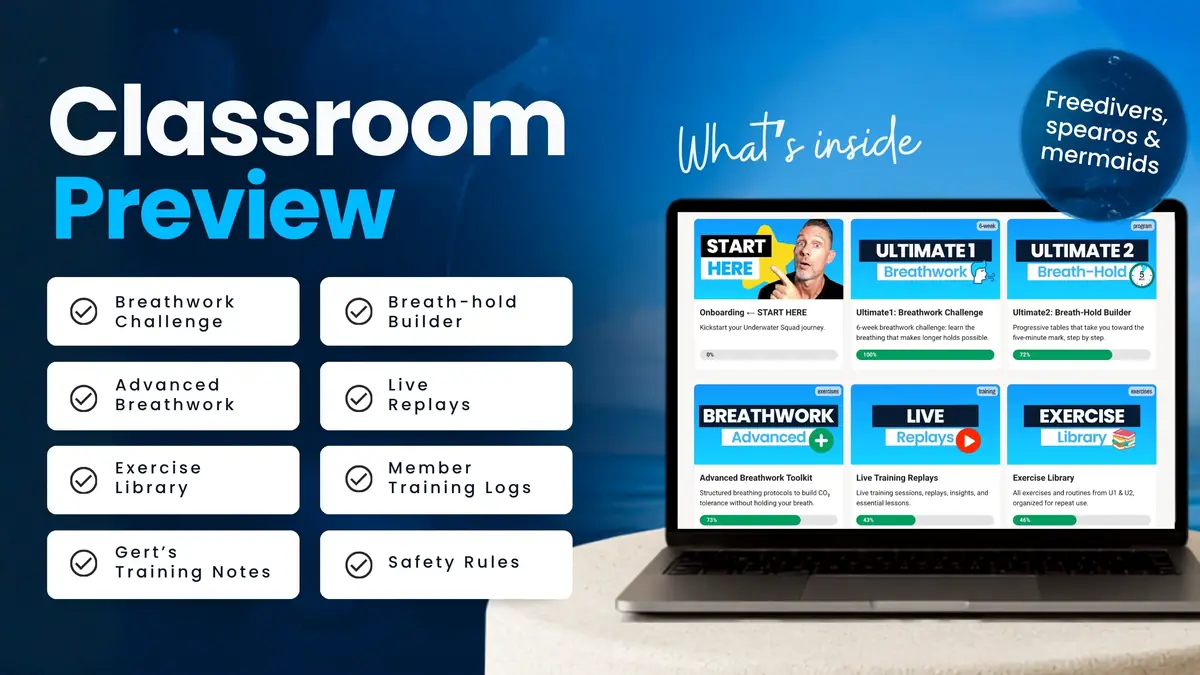
Start here. Fifteen minutes a day of guided breathing that teaches the mechanics behind a longer hold.
Progressive tables that walk you toward the five-minute mark, step by step.
Every exercise and routine from both programs, organised so you can repeat what worked.
Structured breathing protocols that build CO₂ tolerance without holding your breath at all.
Train along with the group in real time, or use the replay whenever your day allows.
Member logs, Gert's training notes, and the safety rules that keep dry apnea dry apnea.

Where do I start
Three stages, in order. You don't guess what to do next — the classroom tells you.
Six weeks, 15 minutes a day. Learn the breathing that makes longer holds possible before you chase a number.
Progressive tables that take you toward five minutes, with a clear rule for when to move up.
Protocols to keep raising CO₂ tolerance on days when a maximum hold isn't the right call.

Recent PBs from the Squad
The community
Members post their sessions in the Wins feed — new PBs, first four-minute holds, and the weeks where nothing moved. It's a running record of what this training looks like for people with jobs and families.
Your coach
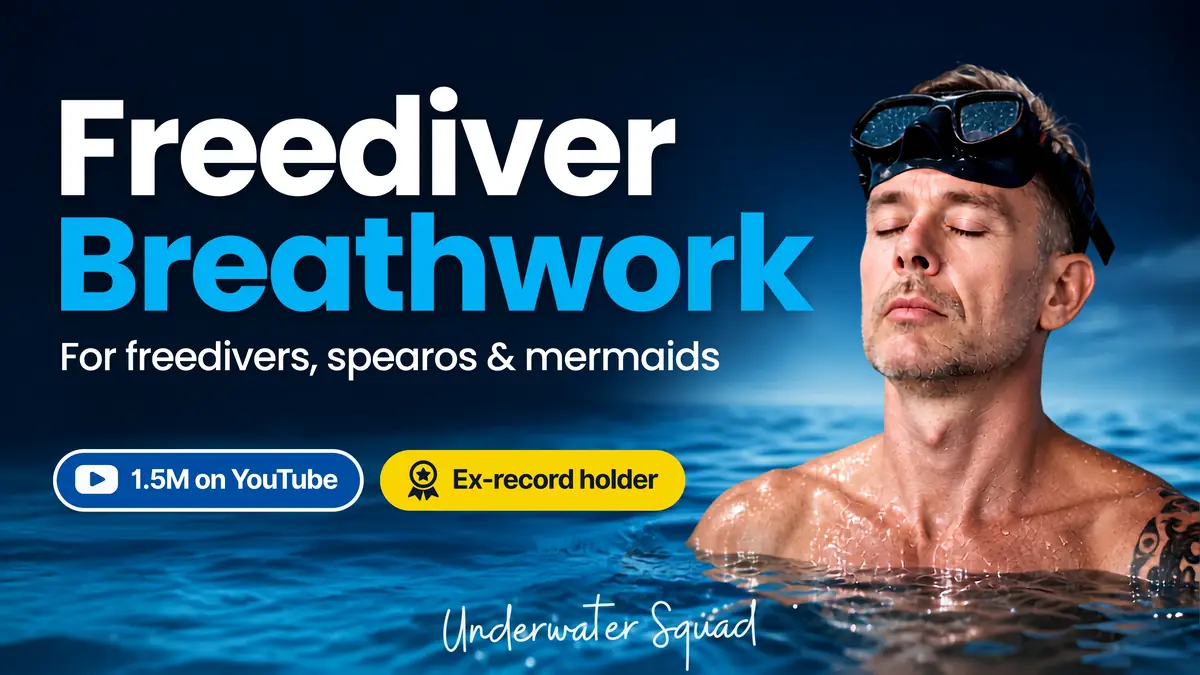
Freediving instructor, former national record holder, and 1.5 million subscribers on YouTube. I've spent years watching people try to force a longer breath-hold and get nowhere. The ones who improve fastest are the ones who learn to relax first.
Freediving isn't about chasing numbers. Holding your breath teaches you to be comfortable with the uncomfortable, and that translates straight into everything else. Calm first, numbers second. Then the numbers come anyway.
Keep reading
Join the Squad and follow the 6-week Breather Challenge from day one. Fifteen minutes a day, dry, at home. Seven-day free trial.
Join with the 7-day free trial