Keep reading
Home › FAQ
Safety, timelines, plateaus and the things people ask before joining.
No. Everything is dry training you can do lying down at home in about 15 minutes a day. CO₂ tolerance and relaxation are built on land; the water is where you spend what you built.
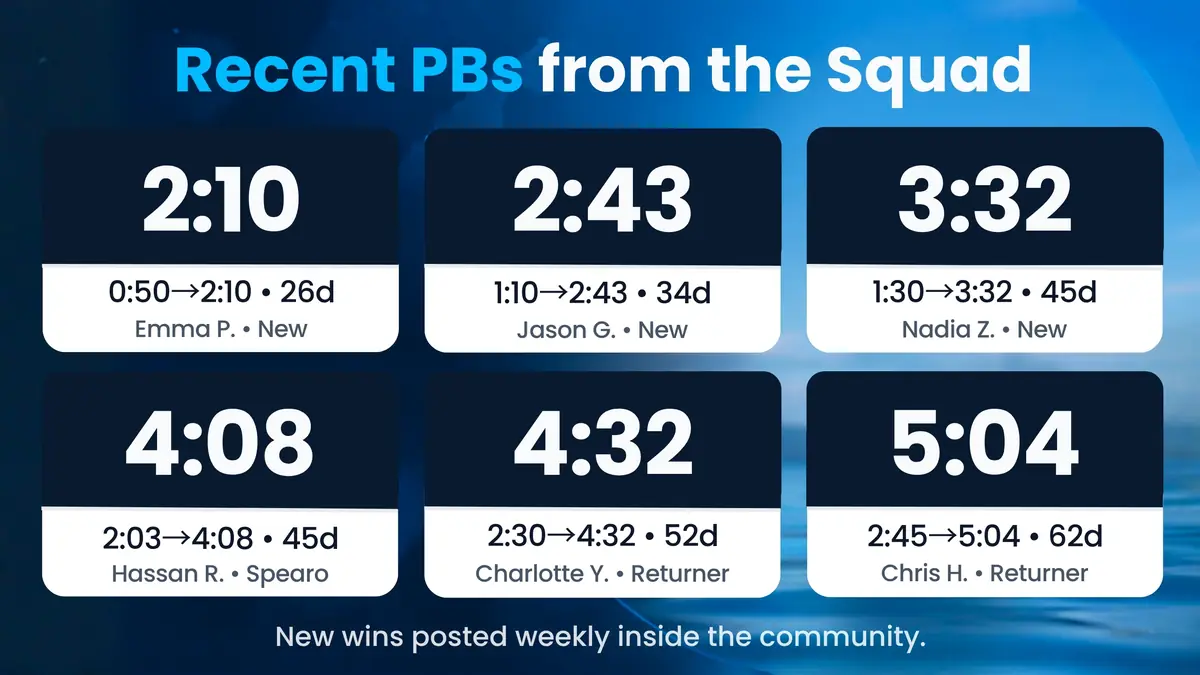
Most members feel the first contraction arriving later within two to three weeks, and see their maximum hold move within four to six. Doubling a starting time inside two months is common when the training is daily, though results depend on where you start and how consistent you are.
Dry breath-hold training, done lying down and away from water, is low risk for healthy adults. Always lie on a bed or sofa — never stand, because you could faint and hit your head — and wear nothing on your face when training alone. In water you need a trained freediver as a buddy; a lifeguard, a partner or a friend does not count. If you're pregnant or have heart, lung, blood-pressure or seizure conditions, check with a doctor first.
Only marginally. Lung volume sets a ceiling most people never reach. What ends a typical hold is rising CO₂ and the tension that comes with fighting it — both trainable, unlike your ribcage.
In a CO₂ table the rest is too short for carbon dioxide to clear, so you train tolerance to the urge to breathe. In an O₂ table the rest is long enough for CO₂ to return to baseline, but the repeated holds drive oxygen down, training your threshold to hypoxia. Beginners should focus almost entirely on CO₂ tables. Three to start from are on the CO₂ tolerance training page.
Two to three sessions a week at most, and one table per session. You can train more often than that, just not with tables every day — mix in light breathwork or normal sessions in between. Moderate intensity, never high; high intensity stresses the nervous system and makes the practice unsustainable.
Nearly always one of three things: you're testing your maximum too often, you're tense during the hold without noticing, or you're under-recovered from life outside training. Post your log in the community and it usually takes one round of questions to spot which.
Fifteen minutes. That's the design constraint the whole programme was built around. Frequency matters far more than session length for this kind of adaptation.
Yes. The onboarding tells you exactly where to start, and the 6-Week Breather Challenge assumes no prior experience. Members have arrived at 45 seconds and at four minutes.
Same fundamentals, different emphasis. Spearos want repeatable bottom time and quick recovery rather than one long static. See the spearfishing page for how to weight the training.
All programs, the exercise library, the advanced breathwork toolkit, weekly live training with replays, member training logs and the safety rules. There's a 7-day free trial, so you can look through the whole classroom before deciding.
Keep reading
Join the Squad and follow the 6-week Breather Challenge from day one. Fifteen minutes a day, dry, at home. Seven-day free trial.
Join with the 7-day free trial